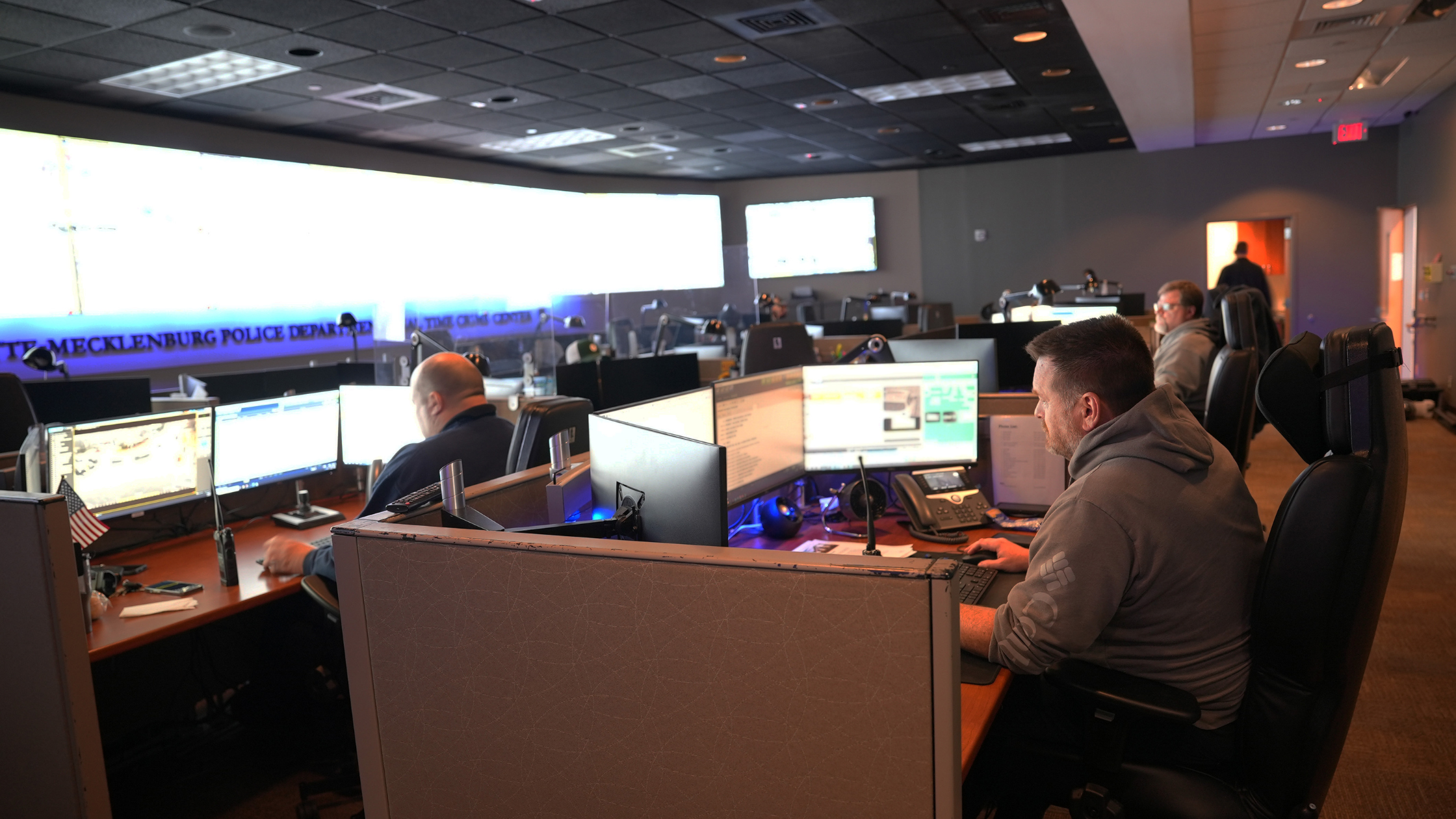
Think a behind-the-scenes team armed with hundreds of monitors, 1,000+ cameras, access to state-of-the-art databases, and the technology and expertise to fight crime in real time sounds like the stuff of Hollywood fiction?
Then allow us to introduce Charlotte-Mecklenburg Police Department’s Real Time Crime Center (RTCC).
Established in 2013, the RTCC is CMPD’s hub for collecting and analyzing visual surveillance, criminal intelligence and other data. Think of it as the brain that multiplies the department’s eyes and ears to stop crimes before they happen, mitigate public safety threats already underway, and uncover intelligence essential to resolving open investigations.
For example, the RTCC:
- Monitors all top-priority calls for service in Charlotte. When a major violent crime or serious accident happens, the team tunes into nearby camera technology to relay real-time info to responding officers.
- Tracks electronic monitoring participants with outstanding warrants and coordinates with patrol officers and other units to arrest them.
- Assists other specialized units in tracking and locating suspects and vehicles.
- Watches over special events, protests and demonstrations and, if needed, documents criminal activity and property damage.
- Reviews license plate reader software and camera data, verifies hits, and locates and tracks vehicles to assist responding officers.
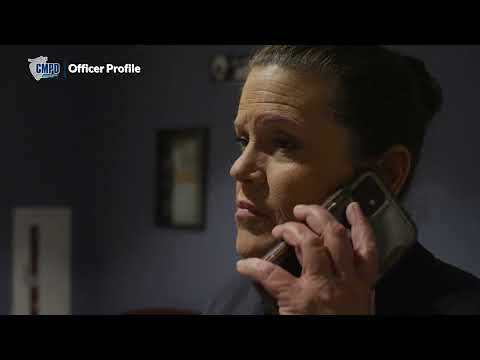
We recently asked RTCC Detective Amanda Williams to tell us more about working in this specialized unit. Keep reading to see what she says she enjoys most, what she considers essential skills for RTCC officers, and her advice for those who want to pursue a career with this team.
What strengths or skills make someone a good candidate for the RTCC?
You must be able to multitask. While working an active investigation, we use different databases, and work multiple cameras and sometimes multiple radio channels at the same time. We work as a team and divide responsibilities to search for information faster. The faster we can get information and identify a possible suspect, the higher the chances to make an arrest.
You also have to be a team player. Working together and using all available sets of eyes to ensure that information we provide is as accurate as possible is extremely important. We often check behind one another and confirm makes, models and colors of vehicles, clothing descriptions, etc., before information is passed along to officers.
What do you enjoy most about your work in this unit?
I really enjoy my team – we are a family! We all have the same goals and strive for excellence in everything we do. We work together on everything and are always there to help each other. We enjoy being able to fill in the blanks and provide the missing pieces to so many different investigations, thus making Charlotte safer for its residents.
Why did you choose to join the RTCC?
While assigned to patrol in the Independence Division, I knew several officers who worked in the RTCC and I spoke with them about what they did. I got the opportunity for a weeklong ride-along and loved it. After completing my ride-along, I was granted access to the cameras in the division. I began using the cameras, databases and software for my calls for service, and I was finding suspects, suspect vehicles and information that I had never been able to before. I enjoyed putting the pieces together and found it extremely rewarding to complete my own investigations from start to finish.
What training, education or certifications are required to work in your unit?
All members of our team are trained on license plate recognition cameras and software. In addition, we’re certified users for a variety of law enforcement databases and electronic monitoring tools.
The RTCC operates the Command Center at Charlotte’s Law Enforcement Center during special events, and uses a satellite van on scenes, so additional training is required. Officers also need working knowledge of our camera software system, and complete additional training when we gain access to new systems.
What do you wish more people knew about the RTCC team’s expertise?
CMPD was one of the first police departments in the nation to open an RTCC. Now, agencies across the U.S. are starting their own RTCCs and this is seen as the future of policing.
The information we gather is crucial. Today people want video evidence, and in many cases, we have it for our investigations. RTCC’s goal isn’t to spy on the daily activities of the average citizen. Rather, it’s our job to observe and capture criminal activity, apprehend suspects and keep the citizens of Charlotte safe. We take great pride in the work we do.
What’s the most common misconception people have about what you do?
Many people think it’s all about the cameras, but there is so much more going on behind the scenes. We gather information on individuals involved in criminal activity; stay up-to-date on “be on the lookout” (BOLO) alerts for suspects and vehicles; work active investigations with patrol; coordinate with CMPD’s helicopter and K9 units; assist other specialized units and outside agencies; track subjects on electronic monitors; and run the Command Center. We don’t just react when calls come in. We also work proactively to prevent the next crime.
What is the most rewarding part of working in the RTCC?
We have a saying in the RTCC: “Make magic happen.” We enjoy the challenge of working calls with almost no information, and very little suspect or vehicle descriptions. We work our “magic” and develop leads for officers to follow. Watching a crime occur on-camera before the 911 call, giving officers specific and detailed descriptions, and then assisting officers with tracking and apprehending suspects are extremely rewarding. We have also located several missing persons with special needs, which is especially close to my heart.
Another rewarding part of this job is helping keep our officers safe. There have been numerous times when we’ve kept watch over officers on traffic stops, calls for service or foot pursuits via the cameras. We have observed suspects start to fight officers, and are able to get backup units to the officer quickly. We have no interaction with the public, and we are no longer “boots on the ground,” so to be able to assist our colleagues this way is invaluable.
What law enforcement roles did you hold prior to joining CMPD?
I served as a law enforcement officer in the U.S. Navy for more than 11 years. While in the Navy, I was a patrolman for two years and a detective for one year. My last position in the Navy was in executive protection.
When I joined CMPD in 2008, I was assigned to the third shift in the Independence Division for seven years. I also spent two years with the Crime Reduction Unit (CRU).
What drew you to CMPD specifically?
I was drawn to the many different opportunities CMPD offers. Many smaller departments didn’t have as many specialized units or chances for advancement. I have worked on patrol, in crime-reduction units and the RTCC. I have volunteered as a range safety officer, I work with the Crisis Intervention Team, and I also assist as a role player for recruit training at the Academy.
With so many units within the department, officers have the opportunity to explore many different areas of interest during their careers.
What’s your advice for someone who wants to pursue a career in a CMPD specialized unit?
Find someone already working in the position or unit and pick their brain about everything you can. Soak up the information like a sponge. Complete the training available to you that pertains to what that unit does. Request a ride-along or stop in and chat with them in your off time. Showing interest and taking personal time to shadow or sit in goes a long way. It shows your desire and commitment to learn and be part of the unit in the future.
Accelerate Your Career Here
Ready to join the men and women of CMPD? Start your new trainee, lateral entry or intermediate entry application today.
. . .