If you’re someone who’s naturally curious and enjoys the challenge of sifting through clues to unlock mysteries, a career as a crime scene technician might be for you.
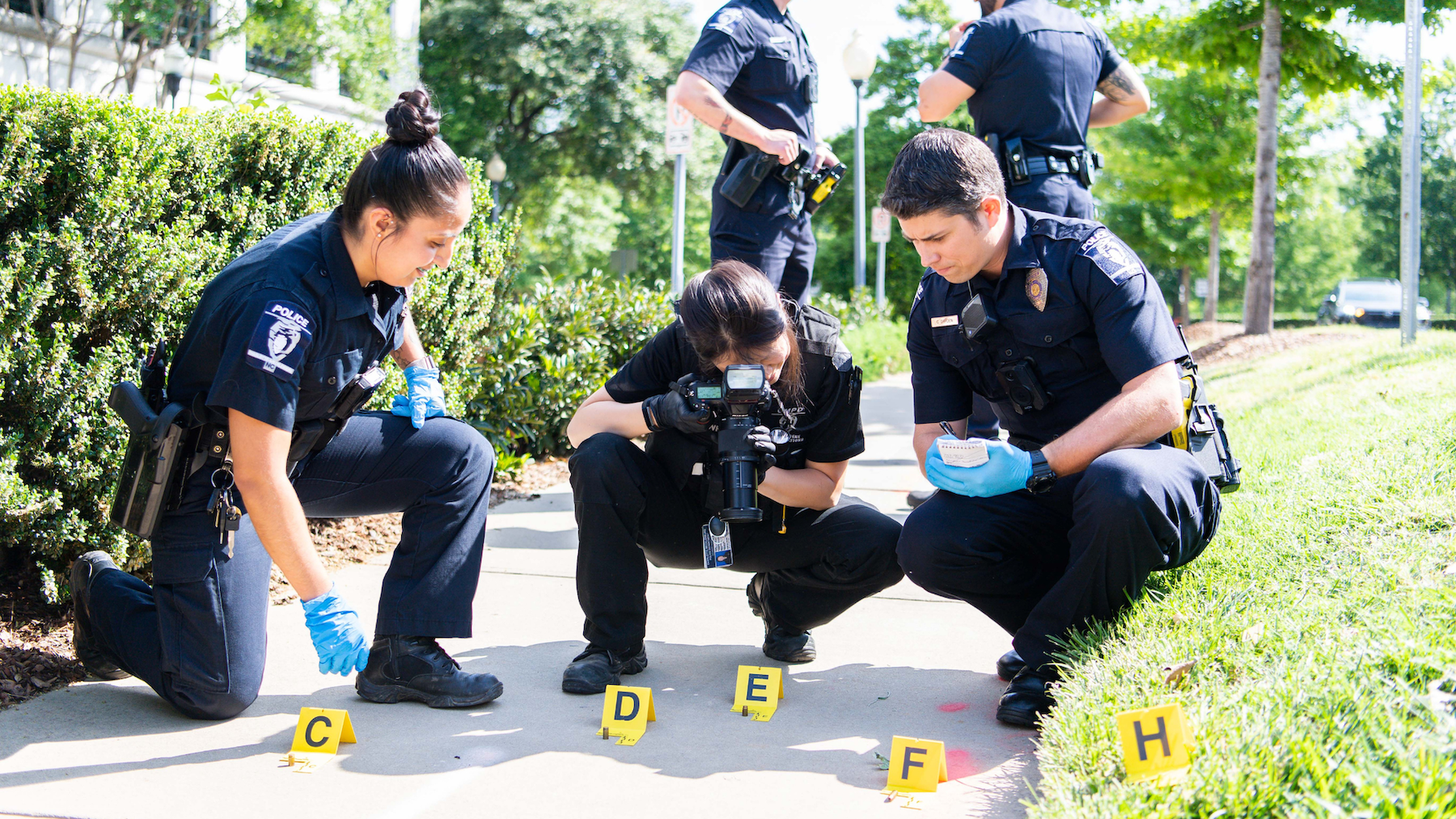
These critical civilian roles within the Charlotte-Mecklenburg Police Department collect, document and preserve crime scene evidence. This helps detectives identify suspects, determine what happened during crimes and ultimately bring those responsible to justice.
We asked CMPD Crime Scene Technician Corey Pollock to tell us more about a day in the life, including how technicians handle emotionally difficult scenes and the most rewarding aspects of the job.
What inspired you to become a crime scene investigator?
I’ve been interested in forensic science since I was young. In high school, I took specialized classes and was very interested in how various techniques could be used to help in an investigation.
I earned minors in criminal justice/criminology and forensics during my time as an undergraduate at The Ohio State University, and obtained a master’s degree in forensic anthropology at Boston University. Forensics is always changing and requires professionals to continually adapt to the evolving technologies. You can always learn something new through continuing education classes and training courses offered by other professionals.
Do you have a typical day or week? What does it look like?
One of the exciting and challenging aspects of this job is that each day is different. Our daily operations depend on what’s happening across Charlotte.
Days often require driving to multiple crime scene calls, which can range from car and house break-ins all the way up to robberies, sexual assaults and homicides. These calls are located in different areas across the city.
Even similar crime scene calls can require different processing techniques. We often rely on information from the officers and people within the community to understand what happened at each scene before we arrived.
How do you work with CMPD officers and detectives at a crime scene and beyond?
We typically have at least one officer on every scene. We rely on them to provide scene security and prevent any scene contamination before we arrive to collect the evidence. Officers and detectives often have the necessary information on what occurred at each scene, which is helpful for us to process each scene as best as we can.
What drew you to work for CMPD?
After graduating from my master’s program, I applied to several forensics positions. Charlotte is a large area and it seemed like it would provide opportunities that would challenge me in a positive way. I was interested in working with a larger police department, where there would be different techniques and more technologies for processing crime scenes.
What’s the most common misconception people have about what you do?
People often believe that each day is filled with gut-wrenching sights and very emotional or challenging scenes. Some days expose us to those kinds of situations, but most days comprise less violent crime scene calls where we make a difference by collecting fingerprints or DNA to help the investigation.
People also believe that we can do the things that they see on the “CSI” television shows. Many aspects of those shows are not consistent with real-life scene processing, and sometimes it can take time for us to process the scenes or for the evidence to be processed.
What do you wish more people knew about your expertise?
Crime scene investigators can play a vital role in an investigation when we are able to collect fingerprints, DNA or other items such as shoe prints, tire tread patterns, etc., from a crime scene. We can lift fingerprints that place a suspect at a scene, which can give the assigned detective a lead to continue the investigation by providing the name of an individual to question.
What’s the most rewarding thing about your job?
I love this job because it gives me the opportunity to give justice to the victims. I get to use my expertise and experience every day to process several types of scenes, and I get to communicate with individuals that have very different worldviews or experiences. It is very rewarding to ease the pain and suffering of each victim as best as I can and help them in any way possible.
How do you handle the emotional aspects of investigating crime scenes?
Many scenes can be emotional and difficult to process. Each crime scene investigator has their own past experiences and emotional triggers, so we often rely on each other to stay strong and respond to each scene with an eagerness to make a difference. I focus on being able to compartmentalize enough to get justice for victims and their families.
What educational background and certifications are required for your position?
The minimum qualifications for a crime scene investigator position are a high school diploma or an associate’s degree, but a bachelor’s degree or master’s degree is often preferred. Any internships or work experience within a science-related discipline help as well.
What strengths or skills make someone a good crime scene investigator?
Many individuals within the crime scene unit are very curious and have a desire to understand what or why something happened. We have to ask several questions to gain all the information necessary to fully process each scene. We also have to be determined enough to not quit until we are finished. Each day can be long, and some scenes can be emotionally and physically exhausting, but we have to be strong and have the desire to help the best we can.
What role does teamwork play in your investigations?
Teamwork plays a large role in processing crime scenes. Not only do we have scenes where multiple investigators and supervisors work together, but we often rely on officers and detectives to provide necessary information for processing each scene. Detectives often rely on information from us about what evidence we collected or located on-scene.
Sometimes we are not able to process evidence for fingerprints or DNA at the crime scene, so the fingerprint and biology laboratories rely on us to collect evidence so they can process the items at their facilities. An investigation requires teamwork from multiple individuals within the department to help the community.
What advice do you have for someone interested in becoming a crime scene investigator?
Take classes and training courses to grow your knowledge and explore what interests you most.
In addition, take advantage of internships, volunteer or shadow professionals to expand your experiences and give you great insights on what working professionals experience daily.
Finally, attend conferences to learn about new techniques or technologies within the field and network with working forensics professionals.
Learn more about CMPD’s specialized units in our previous Q&As with detectives and leadership from the department’s Real Time Crime Center and Criminal Intelligence, Homicide and Domestic Violence units.
Accelerate Your Career Here
Ready to join the men and women of CMPD? Start your new trainee, lateral entry or intermediate entry application or browse open civilian positions in the crime scene unit and other departments.
. . .