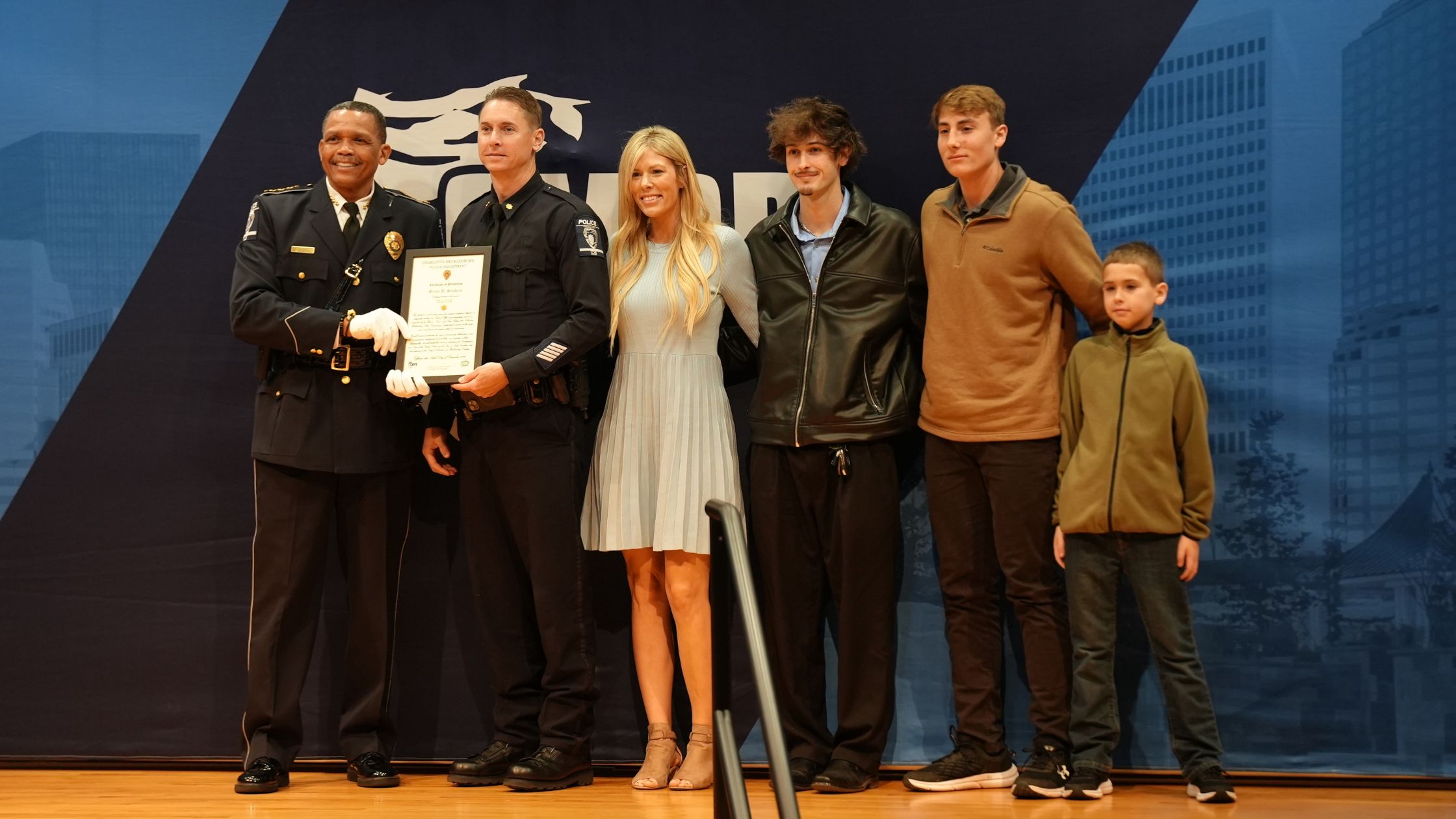
Major Brian Sanders has a big job. As commander of Charlotte-Mecklenburg Police Department’s Recruitment and Training Bureau, he oversees all of the agency’s activities related to recruiting the nation’s best and brightest men and women to serve the City of Charlotte as sworn officers.
His road to get to his position with CMPD wasn’t easy. Read on to see how the word “no” placed Major Sanders on his career path – and why, looking back, he wouldn’t have it any other way.
What inspired your interest in a career in law enforcement?
I grew up in a suburb of Dallas called Sunnyvale, Texas. My dad was a Texas highway patrolman for 10 years before I was born, and I grew up hearing his stories. My dad has always been my hero, so policing is something I have always loved. Seeing my dad’s pictures and hearing his stories made me see law enforcement officers as superheroes, and I wanted to be part of it.
Our house was burglarized when I was 16. I came home to find the front door broken open. We lived in a semi-rural area, so I called the Dallas County Sheriff’s Department to investigate. I’ll never forget the deputy who responded. He became a family friend and would stop by on summer nights when my friends were over playing basketball in the driveway or just hanging out. I rode along with him many times as well, so those experiences solidified my future in law enforcement.
You applied to become a police officer in Texas but were denied. How did that shape your path?
I applied to join a police department in a suburb of Dallas as soon as I was eligible at 21. I was turned down. Shortly after, I learned that CMPD was hiring. My parents had already relocated here, and I knew this was the job I was made to do, so I applied and moved here before I even knew if I had been hired. It was definitely a leap of faith, but I wanted it more than anything! Being turned down was what opened the door to the incredible career I have now.
What kept you motivated to pursue your goal of becoming a sworn officer after that setback?
Though I was “rejected” by the Texas police department, I knew God had designed me for this profession. Nothing could stop me. It was that feeling inside me that kept me going. It was just a matter of where I was going to have the honor to serve – not “if.”
What did you learn from not being accepted the first time that helped you in your career today?
I learned that encountering and overcoming challenges is part of achieving any goal, dream or purpose. To this day, when I look at the Uptown skyline – especially at night – I’m so thankful the police department in Texas rejected me.
Throughout my career, in various assignments and promotions, there have been times I wasn’t accepted or didn’t make the cut. That initial rejection back in my early 20s taught me there is always a reason, and with persistence, I’ll find it.
Every single time I’ve been turned down has put me on a path to higher responsibility and opportunity. With the right perspective, failure is always an opportunity.
What advice would you give someone who faces rejection in their pursuit of a police career?
There are many reasons someone may not qualify for a career in policing. However, if the reason is simply needing more time and life experience, and you believe this is your calling, don’t give up.
Rejection and not making the cut are parts of life. Take the feedback, don’t blame anyone, set the goals you need to achieve to be better and go get it.
How can someone make the most of their career with CMPD once they’re hired?
When I applied in 1997, I was asked why I wanted to be a police officer. My answer, like so many, was “to help people.” I had no idea how that simple answer would transform my life.
A career in law enforcement, specifically at CMPD, has unending potential. Each of us has special interests, desires and goals, both personal and professional. CMPD offers a path for everyone and with determination, everyone can bring all their goals to reality.
For example, I have been able to:
- Help countless people through patrol and specialized assignments; catching offenders; retrieving stolen property; and assisting domestic violence victims and victimized children.
- Teach recruits and current officers as a state instructor and assist other agencies in enhancing their field training programs modeled after CMPD.
- Lead and develop teams in patrol, specialized units for suspect apprehension and investigations units for all types of criminal activity.
- Create new units and protect the President of the United States, along with dozens of elected officials, for more than 12 years.
- Positively impact the business side of the police department, providing needed equipment for all officers and developing new processes for efficiency.
I list all of these assignments with deep appreciation for the opportunities provided by this great department. The bottom line is, you can do just about anything that interests you right here as a sworn officer with CMPD.
Accelerate Your Career Here
Ready to join the women and men of CMPD? Start your new trainee, lateral entry or intermediate entry application or browse open civilian positions.