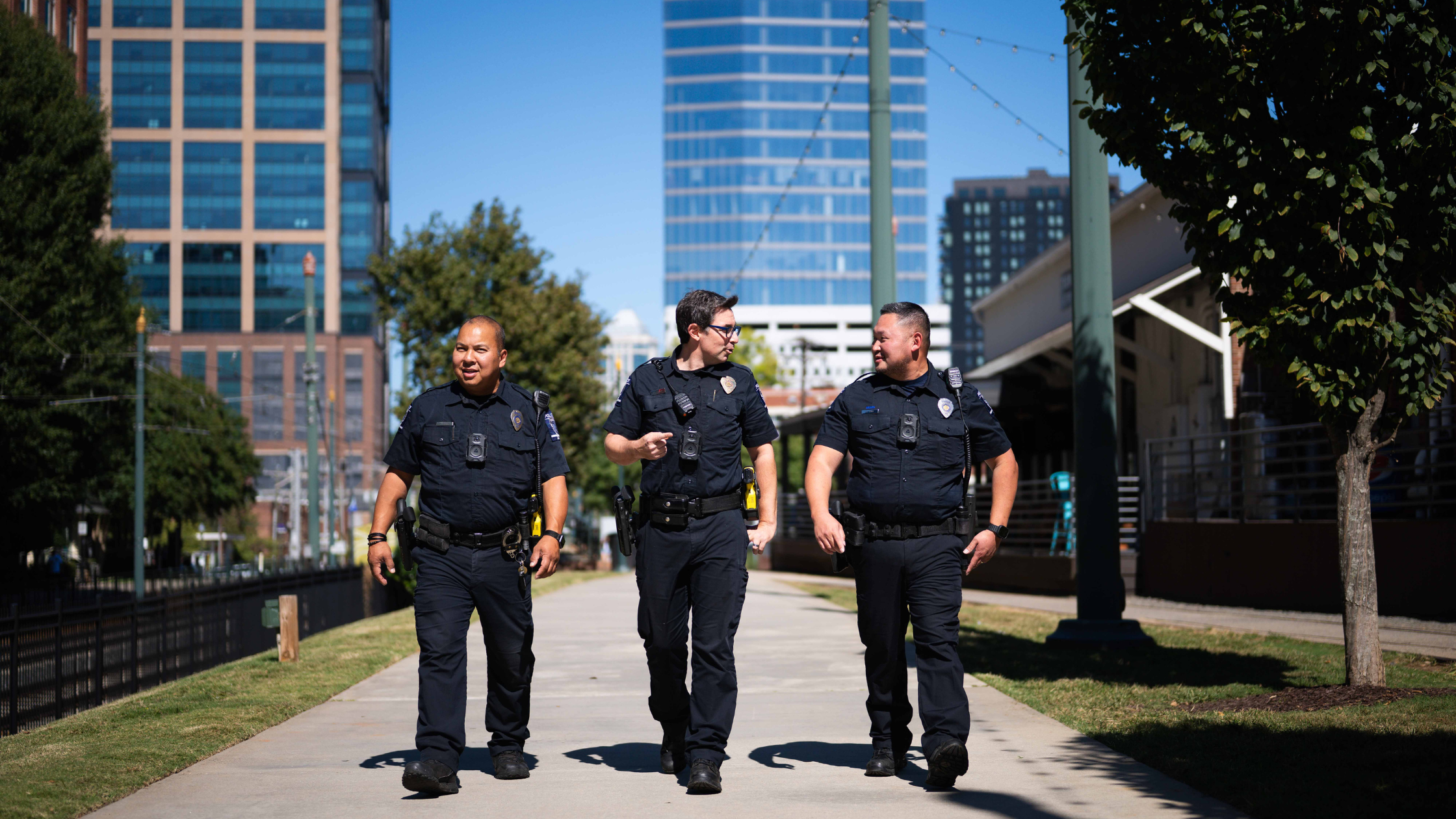
If you’re considering a career with the Charlotte-Mecklenburg Police Department (CMPD), you probably already know some of the basics, and maybe you’ve explored posts like Your Most-Googled Police Recruitment Questions, Answered or 12 Answers to Questions You’re Not Sure You Can Ask Your Recruiter.
As you dig deeper, it’s natural to think about the bigger picture: career paths, daily responsibilities, training timelines and what makes CMPD unique.
That’s why we’re answering more frequently searched questions about becoming a police officer, with a closer look at what those answers mean for you and your career in Charlotte.
What are police officer ranks at CMPD?
Like many large metropolitan departments, CMPD uses a structured rank system that reflects experience, leadership and responsibility. As you gain experience, you can grow into supervisory and command roles over time or move into specialized assignments across the department.
You’ll find numerous opportunities to develop your career – from patrol and investigations to specialized units like K9, SWAT, aviation and more – allowing you to build a path that matches your interests and strengths.
What’s the difference between a Mecklenburg County Sheriff’s Office deputy and a CMPD officer?
As a CMPD officer, you serve the City of Charlotte by responding to calls for service, enforcing laws and working closely with community members to improve public safety.
Sheriff’s offices typically operate at the county level and often focus on jail operations, courthouse security and civil processes. While both are critical to the justice system, CMPD focuses primarily on municipal policing and community-focused service.
What are the different roles within CMPD and law enforcement?
A career with CMPD offers a wide range of opportunities beyond patrol. As you grow in your career, you can pursue assignments in areas like felony investigations, vice and narcotics, school resource officer programs, lake enforcement, helicopter operations, violent crime task forces and more.
You’ll also work alongside professional, non-sworn teammates – from telecommunicators to crime lab scientists – in a collaborative environment focused on public safety and service.
Do you need a degree to become a CMPD officer?
CMPD does not require a four-year degree to apply. You must have a high school diploma or GED, be at least 20 years old, be a U.S. citizen and meet additional background, driving and testing requirements.
While higher education can support long-term advancement, many successful officers begin their careers without a college degree. CMPD also offers educational incentives and pay benefits tied to higher levels of education, recognizing the value that continued learning brings to your career and to the community you serve.
What are the job responsibilities of a CMPD officer?
As a CMPD officer, you’ll help protect life and property, respond to calls, conduct investigations, enforce laws and build strong relationships with the community.
The role requires teamwork, communication and ongoing training, and reflects CMPD’s commitment to community collaboration and professional accountability.
How do you become a CMPD officer?
Your journey begins by submitting an application through the City of Charlotte job portal. From there, you’ll complete assessments, including a written test and physical ability test, followed by a background investigation and interviews.
While the application process might feel intimidating, each step is designed to guide you forward. If you have questions along the way, your CMPD recruiter is here to help.
Through each stage, we’re looking for candidates who demonstrate integrity, discipline, strong communication skills and a commitment to service. These are qualities that typically set strong applicants apart.
How long is the CMPD Training Academy?
If selected, you’ll complete Basic Law Enforcement Training (BLET) at the CMPD Training Academy. The Academy lasts 32 weeks, or eight months, and prepares you through classroom instruction, physical training and scenario-based learning before you move into field training.
What questions are asked in a CMPD interview?
CMPD interviews focus on qualities like integrity, self-discipline, work ethic and selflessness – characteristics that are essential for success in law enforcement.
You may be asked about your past experiences, decision-making and motivation for pursuing this career. Just as important as preparation is honesty. Always be truthful throughout the process, and never attempt to hide or misrepresent information. Transparency helps build trust and allows recruiters to fully understand your background.
You may worry that something in your past could be an automatic disqualification, but more often than not, that isn’t the case. Recruiters can often work through past mistakes when they’re disclosed early, but integrity issues or dishonesty during the hiring process are an automatic disqualification.
What jobs can you get with a criminal justice degree at CMPD?
A criminal justice degree can support a variety of career paths within CMPD, including investigative roles, specialized units and leadership opportunities as your career progresses.
CMPD also offers civilian career paths in areas like telecommunications, forensic science, analysis and support services, giving you multiple ways to serve the community.
Accelerate your career here
A career with CMPD gives you the chance to serve one of the nation’s fastest-growing cities while building a meaningful, dynamic future. From comprehensive training to diverse career paths, you’ll find opportunities to grow, lead and make a difference.
Ready to join the men and women of CMPD? Start your new trainee, lateral entry or intermediate entry application or browse open professional positions in telecommunications and other departments.